


Restaurant Vocabulary: Essential English Word List & Phrases for Ordering Food (With Story, Quiz & Free Worksheet)
Updated: Aug 6
Have you ever visited a restaurant in an English-speaking country and felt nervous about ordering your meal?
Don't worry—you're not alone!
Learning restaurant vocabulary is one of the most useful English skills for everyday life. Whether you're travelling, studying abroad, or simply practising English conversations, knowing the right words can make dining out much easier and more enjoyable.
In this lesson you'll learn restaurant vocabulary through a fun story, easy explanations, example sentences, quizzes and downloadable worksheets.
By the end of this lesson, you'll know how to:
✅ order food confidently
✅ understand restaurant menus
✅ ask for the bill politely
✅ use common restaurant expressions naturally
Let's begin!
Why Learn Restaurant Vocabulary?
Restaurant English is one of the most common real-life situations ESL learners experience.
These words are useful when you:
travelling overseas
eating in cafés
visiting restaurants
ordering takeaway
talking about food
making reservations
asking for recommendations
The best way to remember vocabulary isn't memorising long lists.
It's learning words through stories.
Learn Restaurant Vocabulary Through a Story
🥘 A Delicious Night Out
It was a beautiful evening when Sarah and John decided to visit Bella's Bistro, a cosy restaurant they had heard so much about.
As soon as they entered, they were greeted by a friendly waiter who showed them to a table near the window.
"Here are your menus," the waiter said with a smile.
Sarah and John opened them and began to look at the appetisers.
Sarah was in the mood for something light, so she decided to order the bruschetta, while John was craving something with more substance and chose the mushroom soup.
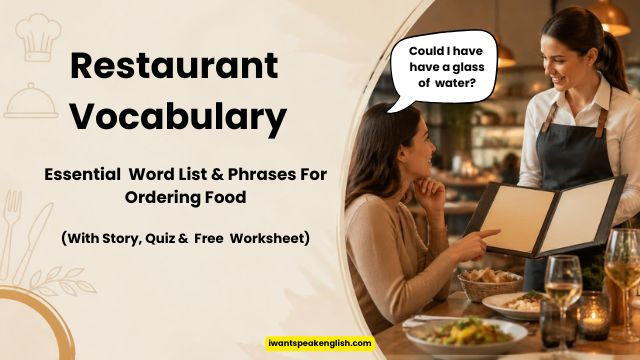
"Have you decided on your main course?" the waiter asked after they finished with the starters.
"I think I'll have the grilled salmon with some roasted vegetables on the side," said Sarah.
John wasn't sure, but he was tempted by the steak with mashed potatoes.
"I'll go with the steak, please," John said finally.
The waiter nodded and asked, "How would you like your steak cooked?
Rare, medium, or well done?"
"Medium, please," John replied.
As they waited, they talked about their plans for the week. The restaurant was quiet and cosy, and the ambiance was perfect.
Soon, the waiter returned with their drinks. Sarah chose a glass of white wine, while John opted for a cold beer.
The food arrived quickly. The presentation was beautiful, and the smell was irresistible.
Sarah couldn't wait to try the salmon, and John was eager to dig into his steak. They ate happily, savouring every bite.
When they were finished, the waiter came to clear the table and asked, "Would you like to see the dessert menu?"
"Yes, please," said Sarah.
She decided to have the chocolate mousse, while John ordered the apple pie with vanilla ice cream. The desserts were the perfect end to a delicious meal.
Finally, the waiter brought the bill to the table. John paid, and they left the restaurant, already planning their next visit.
🎥 Watch YouTube video with voice narration for pronunciation & listening practice: 👇 A Delicious Night Out - Restaurant Vocabulary
👀 Watch and Learn! For video lessons that bring our content to life,
🔗 Download Free PDF >> Restaurant Poster
🧐 A Delicious Night Out - Story Comprehension Quiz
What is the first thing the waiter does when Sarah and John enter the restaurant?
A) Takes their orders
B) Gives them the menu
C) Shows them to their table
D) Brings their drinks
Which appetiser did Sarah choose?
A) Mushroom soup
B) Grilled salmon
C) Bruschetta
D) Steak
What did John order for his main course?
A) Grilled salmon
B) Mushroom soup
C) Steak with mashed potatoes
D) Bruschetta
How did John want his steak cooked?
A) Rare
B) Medium
C) Well done
D) He didn’t care
What drink did Sarah choose?
A) Cold beer
B) White wine
C) Water
D) Lemonade
What is the term used for small dishes served before the main course?
A) Side dishes
B) Main courses
C) Appetisers
D) Desserts
What did Sarah order for dessert?
A) Chocolate mousse
B) Apple pie with vanilla ice cream
C) Cheesecake
D) Tiramisu
What did John order for dessert?
A) Chocolate mousse
B) Apple pie with vanilla ice cream
C) Fruit salad
D) Ice cream sundae
What did the waiter bring after they finished their meal?
A) The dessert menu
B) The bill
C) A glass of wine
D) More appetizers
What word describes the atmosphere or mood of the restaurant?
A) Waiter
B) Presentation
C) Ambiance
D) Bill
🔑Answer Key:
C - Shows them to their table
C - Bruschetta
C - Steak with mashed potatoes
B - Medium
B - White wine
C - Appetisers
A - Chocolate mousse
B - Apple pie with vanilla ice cream
B - The bill
C - Ambiance
Restaurant Vocabulary List
Now let's review the words you saw in the story.
📅 Reservation
Pronunciation: /ˌrez.əˈveɪ.ʃən/
Meaning: An arrangement made in advance to book a table at a restaurant for a specific date and time.
Example Sentence: We made a reservation for two at 7 p.m.
More Examples:
I'd like to make a reservation for Friday evening.
Do you have a reservation?
It's a good idea to make a reservation before visiting a popular restaurant.
Common Collocations:
make a reservation
cancel a reservation
confirm a reservation
reservation for two
dinner reservation
restaurant reservation
Useful Expressions:
I'd like to make a reservation, please.
I have a reservation under the name Smith.
Can I change my reservation to 8 p.m.?
I'd like to cancel my reservation.
Quick Tip
💡Many busy restaurants require reservations, especially on weekends and public holidays. If you don't have one, you can ask:
"Do you have any tables available?"
👋 Host / Hostess
🔊 Pronunciation: /həʊst/ • /ˈhəʊ.stəs/
Meaning: The person who welcomes guests, checks reservations, and shows them to their table.
Example Sentence: The hostess greeted us with a warm smile.
More Examples:
The host showed us to a table by the window.
The hostess checked our reservation.
Ask the host if there's a table available.
Common Collocations:
greet guests
restaurant host
friendly hostess
show someone to a table
welcome customers
Useful Expressions:
Good evening. Do you have a reservation?
Please follow me to your table.
Your table is ready.
Quick Tip 💡
The words host and hostess are becoming less common in some places. Many restaurants simply use host for everyone.
📖 Menu
🔊 Pronunciation: /ˈmen.juː/
Meaning: A list of food and drinks available at a restaurant.
Example Sentence: Could I see the menu, please?
More Examples:
The menu has many vegetarian dishes.
We looked at the dessert menu.
Today's menu includes fresh seafood.
Common Collocations:
menu item
dessert menu
drinks menu
children's menu
menu choice
Useful Expressions:
May I see the menu?
What's today's special?
What do you recommend?
Quick Tip 💡Some restaurants also have a set menu, which includes several courses for one fixed price.
🥗 Appetiser (UK: Starter)
🔊 Pronunciation: /ˈæp.ə.taɪ.zər/
Meaning: A small dish served before the main course.
Example Sentence: We shared garlic bread as an appetiser.
More Examples:
I'd like soup as my starter.
The appetizers arrived quickly.
We ordered three appetizers to share.
Common Collocations:
order an appetiser
share an appetiser
light appetiser
hot appetiser
Useful Expressions:
We'll start with the calamari.
Can we share an appetiser?
What appetisers do you recommend?
Quick Tip 💡In British English, people usually say starter, while appetiser is more common in American English.
🍝 Main Course (US: Entrée)
🔊 Pronunciation: /ˌmeɪn ˈkɔːs/
Meaning: The largest and most important dish of the meal.
Example Sentence: My main course was grilled salmon.
More Examples:
The main course comes with vegetables.
I ordered pasta for my main course.
Our main courses were delicious.
Common Collocations:
order a main course
delicious main course
vegetarian main course
main course menu
Useful Expressions:
I'd like the grilled chicken.
I'll have the steak, please.
What do you recommend for the main course?
Quick Tip💡
In American English, entrée usually means the main course.
🥔 Side Dish
🔊 Pronunciation: /ˈsaɪd dɪʃ/
Meaning: A smaller dish served with the main course.
Example Sentence: The burger comes with a side dish of fries.
More Examples:
Would you like rice or salad as your side dish?
Mashed potatoes are my favourite side dish.
The steak includes two side dishes.
Common Collocations:
side dish
side salad
side of fries
side order
Useful Expressions:
Can I have a side of fries?
I'd like a side salad.
🥤 Beverage
🔊 Pronunciation: /ˈbev.ər.ɪdʒ/
Meaning: A drink, especially one served with a meal.
Example Sentence: Would you like a hot or cold beverage?
More Examples:
Coffee is my favourite beverage.
Soft beverages are available.
We ordered two cold beverages.
Common Collocations:
hot beverage
cold beverage
alcoholic beverage
beverage menu
Useful Expressions:
Can I get something to drink?
Would you like another beverage?
⭐ Special of the Day
Meaning: A dish recommended by the chef that is only available for a limited time.
Example Sentence: Today's special is grilled sea bass.
Common Collocations:
today's special
chef's special
daily special
Useful Expressions:
What's today's special?
I'll try the chef's special.
🥩 Rare • Medium • Well-done
Meaning: Words used to describe how cooked a steak should be.
Example Sentence: I'd like my steak medium, please.
Common Collocations:
cooked rare
medium rare
medium well
well-done steak
Useful Expressions:
How would you like your steak cooked?
Medium, please.
☕ Refill
Meaning: Another serving of the same drink.
Example Sentence: Could I have a refill, please?
More Examples:
Coffee refills are free.
Would you like a refill?
Common Collocations:
free refill
refill your drink
coffee refill
📦 Takeaway (US: Takeout / To-go)
Meaning: Food ordered to eat somewhere else.
Example Sentence: Can I have this as a takeaway?
Common Collocations:
takeaway order
takeaway container
order takeaway
Useful Expressions:
Can I get this to go?
I'd like a takeaway, please.
🧾 Bill (US: Check)
Meaning: A list showing the total cost of your meal.
Example Sentence: Could we have the bill, please?
More Examples:
I'll pay the bill.
Can we split the bill?
The bill came to £42.
Common Collocations:
pay the bill
split the bill
bring the bill
bill total
Useful Expressions:
Could we have the bill, please?
Can we split the bill?
I'll get the bill.
Quick Tip 💡
In the UK, people usually say bill. In the US, check is more common.
💵 Tip
Meaning: Extra money given to restaurant staff to thank them for good service.
Example Sentence: We left a generous tip.
More Examples:
The service was excellent, so we left a tip.
Tipping customs vary by country.
Common Collocations:
leave a tip
generous tip
service tip
tip the waiter
Useful Expressions:
Is service included?
How much should I tip?
🍴 Cutlery
Meaning: Knives, forks, and spoons used for eating food.
Example Sentence: The waiter brought clean cutlery.
Common Collocations:
knife and fork
silver cutlery
extra cutlery
Useful Expressions:
Could I have another spoon?
May I have a knife and fork?
🧻 Napkin
Meaning: A piece of paper or cloth used to clean your hands and mouth while eating.
Example Sentence: She placed the napkin on her lap.
Common Collocations:
paper napkin
cloth napkin
fold a napkin
🧂 Condiments
Meaning: Sauces or seasonings added to food for extra flavour.
Example Sentence: Ketchup and mustard are popular condiments.
Common Collocations:
tomato ketchup
add condiments
condiment bottles
Useful Expressions:
Could I have some ketchup, please?
Do you have any chilli sauce?
🍛 Portion
Meaning: The amount of food served to one person.
Example Sentence: The portions were very generous.
Common Collocations:
large portion
small portion
family portion
Useful Expressions:
The portions are quite big.
Can we share one portion?
🥜 Allergy / Dietary Restriction
Meaning: A food allergy is a medical condition caused by certain foods. A dietary restriction is a food someone avoids because of health, religion, or personal choice.
Example Sentence: I have a peanut allergy.
More Examples:
She's vegetarian.
He can't eat shellfish.
I'm allergic to dairy products.
Common Collocations:
food allergy
dietary restriction
gluten-free
dairy-free
nut allergy
vegetarian option
Useful Expressions:
Does this contain nuts?
Is this dish gluten-free?
I'm allergic to seafood.
Do you have any vegetarian options?
Quick Tip 💡
Always tell your server about any food allergies before ordering. Many restaurants are happy to recommend safe dishes or make small changes to your meal.
🤝 What Are Collocations?
Learning individual words is important, but native English speakers often use certain words together naturally. These common word combinations are called collocations.
For example, we usually say:
✅ make a reservation (not do a reservation)
✅ order food (not ask food)
✅ pay the bill (not give the bill)
✅ leave a tip (not put a tip)
Learning collocations will help you:
🗣️ Speak more naturally and confidently
✍️ Write more like a native English speaker
👂 Understand conversations more easily
📚 Remember vocabulary faster because words are learned together
💡 Tip: Instead of memorising one word at a time, try learning words in pairs or short phrases. It's one of the fastest ways to improve your English! 🚀
Want to learn more?
Explore Learn Collocation Through Stories series
Useful Restaurant Expressions
Situation | Useful Expression |
Asking for a table | A table for two, please. |
Ordering | I'd like the grilled chicken, please. |
Asking for recommendations | What do you recommend? |
Asking about allergies | Does this contain nuts? |
Asking for the bill | Could we have the bill, please? |
Paying | Can I pay by card? |
Practice Exercise: Restaurant Vocabulary
Part 1: Fill in the Blanks
Fill in the blanks with the correct word from the vocabulary list.
We made a __________ for four people at 8 PM.
The __________ greeted us at the entrance and showed us to our table.
Our __________ took our order and recommended the pasta special.
Before the main course, we ordered an __________ of garlic bread.
I like my steak cooked __________, not too raw or too well-done.
Can I get a __________ of orange juice? My glass is empty.
The __________ of the day is grilled salmon with mashed potatoes.
We ordered our food to-go because we wanted to eat at home. The restaurant packed our food as a __________ order.
After we finished eating, we asked for the __________ so we could pay for our meal.
It’s polite to leave a __________ for the waiter if the service is good.
👀⬇️ Scroll down for answer.
Part 2: Match the Words with Their Meanings
Match each vocabulary word with its correct definition.
Word | Definition |
1. Beverage | A) Small dish before the main course |
2. Tip | B) Something sweet served after the main meal |
3. Appetiser | C) The amount of food given per serving |
4. Dessert | D) Extra money given to a waiter for service |
5. Portion | E) A drink, such as coffee, juice, or soda |
⬇️ Scroll down for answer.
🍽️ Part 1: Fill in the Blanks (Answer Key)
reservation
host
waiter
appetiser
medium
refill
special
to go/takeaway
bill
tip
🍕 Part 2: Match the Words with Their Meanings (Answer Key)
Word | Definition |
1. Beverage | E) A drink, such as coffee, juice, or soda |
2. Tip | D) Extra money given to a waiter for service |
3. Appetiser | A) Small dish before the main course |
4. Dessert | B) Something sweet served after the main meal |
5. Portion | C) The amount of food given per serving |
🍽️ 50 Useful Restaurant Expressions in English
Whether you're eating at a café, a fine dining restaurant, or a casual diner, these common English expressions will help you communicate confidently. Practise saying them aloud and try using them in real-life conversations!
👋 Arriving at the Restaurant
1. I'd like a table for two, please.
2. We have a reservation.
3. The reservation is under Smith (name).
4. Do you have any tables available? (You're asking if there's an empty table.)
5. Could we sit by the window? (You're requesting a different table.)
6. We'd prefer a quiet table.
7. Is there a waiting list?
8. How long is the wait?
9. Thank you. This table is perfect.
10. Could we have a high chair? (for child)
📖 Looking at the Menu
11. Could I see the menu, please?
12. May I have the drinks menu?
13. Do you have a children's menu?
14. What do you recommend?
15. What's today's special?
16. What's your most popular dish?
17. Is this dish spicy?
18. What comes with the meal?
19. Does it include a side dish?
20. Can I ask a question about this dish?
🍝 Ordering Food
21. I'd like the grilled salmon, please.
22. I'll have the steak.
23. We'd like to share an appetizer.
24. Can I substitute the fries for a salad?
25. Could I have extra vegetables?
26. I'd like my steak medium, please.
27. Can you make it less spicy?
28. No onions, please.
29. Could I have the dressing on the side?
30. That's everything, thank you.
🥤 Ordering Drinks
31. Could I have a glass of water?
32. I'd like an iced tea.
33. May I have another coffee?
34. Could I get a refill, please?
35. What drinks do you recommend?
🥗 Dietary Needs
36. I'm allergic to nuts.
37. Does this contain dairy?
38. Is this gluten-free?
39. I'm vegetarian.
40. Do you have vegan options?
😊 During the Meal
41. Everything tastes delicious!
42. The food is amazing.
43. Could we have some more bread?
44. Excuse me, could we have some ketchup?
45. Could you clear the plates, please?
💳 Paying the Bill
46. Could we have the bill, please?
47. Can we split the bill?
48. I'll pay by card.
49. Keep the change.
50. Thank you. Everything was wonderful!
⭐ Mini Dialogue: Ordering Food at a Restaurant
Waiter: Good evening! Welcome. Do you have a reservation?
Customer: Yes, it's under Emma Brown.
Waiter: Wonderful. Please follow me.
Customer: Thank you.
Waiter: Here are your menus. Can I get you something to drink first?
Customer: Yes, I'd like an iced tea, please.
Waiter: Certainly. Are you ready to order?
Customer: We'd like to share the garlic bread for our appetiser.
Waiter: Excellent choice.
Customer: I'll have the grilled salmon.
Friend: And I'd like the steak, medium, please.
Waiter: Would you like anything else?
Customer: No, that's everything, thank you.
🎯 Quick Practice
Choose the correct expression.
1. You want to ask for the price to pay.
A. I'd like a refill.
B. Could we have the bill, please?
C. Do you have a reservation?
2. You want to know which dish is recommended.
A. What do you recommend?
B. I'm allergic to nuts.
C. Keep the change.
3. You booked a table yesterday.
A. I'd like a table.
B. We have a reservation.
C. I'd like another drink.
Answer:
✅ B
✅ A
✅ B
🌎 British English vs American English
🇬🇧 British English | 🇺🇸 American English |
Bill | Check |
Starter | Appetizer |
Main course | Entrée |
Chips | Fries |
Crisps | Potato chips |
Takeaway | Takeout / To-go |
Tap water | Faucet water (less common in restaurants) |
Fizzy drink | Soda / Soft drink |
💬 Conversation Challenge
Practise speaking by answering these questions in complete sentences.
What is your favourite restaurant?
What do you usually order?
Have you ever made a restaurant reservation?
Would you rather eat at a café or a restaurant? Why?
Do you usually leave a tip?
What's the best meal you've ever eaten?
Have you ever ordered food in English?
What food would you recommend to a tourist visiting your country?
Now that you’ve learned these must-know restaurant words, it’s time to practise!
🎯 Try using them in a conversation or write a short restaurant dialogue.
💬 Tell us in the comments below ⬇️
Have you ever ordered food in English?
What’s your favourite dish to order at a restaurant? 🍽️
This section contains affiliate links that may earn a small commission.
⭐ Want to Improve Your English Faster?
If you want structured lessons and speaking practice, here are two platforms many learners use:
Try Video-Based Learning
With FluentU you can learn English through real videos, movie clips, interviews, and conversations. It’s great for learning natural expressions and everyday English. Practise with interactive lessons and real-world videos on FluentU
Take Live English Classes
You can also take live online lessons with teachers at British Council.
They offer:
• Private 1-to-1 classes
• Small group classes
• Lessons available 24/7
• AI-powered speaking practice
Perfect if you want structured speaking practice and feedback from teachers.
❓ Frequently Asked Questions - Restaurant Vocabulary
1. What restaurant vocabulary should English learners know?
Some of the most useful restaurant vocabulary includes menu, reservation, waiter, hostess, appetiser, main course, side dish, dessert, bill, tip, takeaway, refill, and beverage. These are common words you'll hear when dining at restaurants or cafés.
2. How do I order food politely in English?
The most polite expressions include:
I'd like the grilled chicken, please.
Could I have the pasta, please?
May I order now?
Could we see the menu, please?
Using please and thank you makes your request sound friendly and respectful.
3. What's the difference between "bill" and "check"?
Both words mean the amount you need to pay after your meal.
🇬🇧 Bill is commonly used in British English.
🇺🇸 Check is more common in American English.
Example:
Could we have the bill, please? (UK)
Could we have the check, please? (US)
4. What's the difference between an appetiser and a main course?
An appetiser (called a starter in British English) is a small dish served before the main meal.
A main course (or entrée in American English) is the largest and most important part of the meal.
Example:
Starter: Soup or garlic bread
Main course: Steak, pasta, or grilled fish
5. What are some useful English phrases for ordering food?
Here are a few common expressions:
I'd like...
I'll have...
Could I have...?
What do you recommend?
What's today's special?
Could we have the bill, please?
These phrases are natural, polite, and commonly used in restaurants.
6. How can I improve my restaurant English?
The best way is to learn vocabulary in context.
Try to:
Read short stories.
Listen to restaurant conversations.
Practise role-playing with a friend.
Watch English videos about dining out.
Learn common collocations instead of single words.
The more often you see and hear restaurant vocabulary in real-life situations, the easier it becomes to remember.
7. What are restaurant collocations?
Collocations are words that naturally go together.
For example:
make a reservation
order food
pay the bill
leave a tip
clear the table
recommend a dish
Learning collocations helps you sound more fluent and natural.
8. Is it okay to say "Can I get..."?
Yes!
Can I get...? is very common in American English and is considered polite in everyday conversations.
Example:
Can I get a coffee, please?
In British English, you'll also hear:
I'd like...
Could I have...
May I have...
All are polite and widely understood.
9. What should I say if I have a food allergy?
Always tell your server before ordering.
Useful expressions include:
I'm allergic to peanuts.
Does this contain nuts?
Is this gluten-free?
I can't eat dairy products.
Do you have vegetarian options?
10. What is the difference between takeaway and dine-in?
Dine-in means you eat your meal at the restaurant.
Takeaway (UK) or takeout/to-go (US) means you take your food home or eat it somewhere else.
Example:
We'd like to dine in.
Can I get this to go?
11. Why should I learn vocabulary through stories?
Stories help you understand how words are used in real conversations rather than memorising isolated vocabulary lists.
Learning vocabulary through stories can help you:
remember new words more easily
improve your reading and listening skills
understand natural English
build confidence when speaking
That's why every lesson in our Learn Vocabulary Through Stories series includes a story, vocabulary explanations, quizzes, and practical activities.
12. Is this lesson suitable for beginner English learners?
Yes! This lesson is designed for A2–B1 (Pre-Intermediate to Intermediate) English learners.
You'll learn:
Essential restaurant vocabulary
Useful everyday expressions
Real-life conversations
Interactive exercises
Speaking practice
Printable worksheets
Whether you're learning English for travel, work, or everyday life, this lesson will help you communicate more confidently in restaurants.
How do you order food in English for beginners?
Start with simple, polite expressions like "I'd like...", "Could I have...?", or "May I order the chicken, please?" These phrases are easy to learn and commonly used in restaurants around the world.
What English should tourists know before visiting a restaurant?
Tourists should learn useful phrases such as:
I'd like a table for two.
Could I see the menu?
What do you recommend?
I'd like the pasta, please.
Could we have the bill?
These expressions will help you order food confidently while travelling.
What is the easiest way to remember restaurant vocabulary?
One of the most effective ways is to learn vocabulary through stories. Reading stories, practising dialogues, completing quizzes, and using new words in conversation help you remember vocabulary naturally and use it with confidence.
You may also enjoy:
🔥 Don't forget to SHARE this post with friends who are learning English!
Let’s make English learning fun and delicious. 😋✨
🎥 Related Videos: YouTube Channel Playlist
📚Prefer Reading?
🔗 For more food related posts check out the links below ⬇️
Love This Content? Get more delivered to you! Sign up for our weekly email with fresh ideas for learning English.
Don't Just Read, Watch! Subscribe to our YouTube channel to complement this blog post with video tutorials and explanations.


Comments