


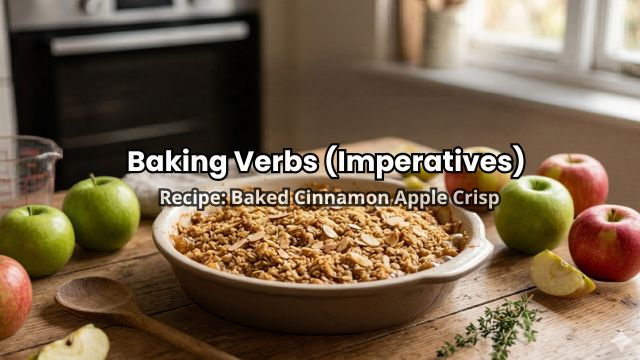
Baking Verbs (Imperatives): Recipe - Baked Cinnamon Apple Crisp
Updated: May 28
Imperative Verbs for Baking & Preparation Methods
Do you know the secret ingredient to a perfect recipe? It isn’t just cinnamon or sugar—it’s Imperative Verbs.
In English, we use the "imperative mood" to give orders, warnings, or instructions. Because a recipe is a series of instructions, it is the perfect way to practise your action words.
Related post
👀 Watch and Learn! For English grammar story video lessons that bring this content to life, subscribe to our YouTube channel.
🎥 Watch and Learn!
Join Emily and Tom as they embark on a fun-filled baking adventure in this short story.
Today, we are learning 13 essential baking verbs while making a delicious, gluten-free Baked Cinnamon Apple Crisp.
13 Baking Verbs (Imperatives) - Recipe

place
preheat
grease
toss
add
combine
pour
spread
bake
continue
remove
set
serve
What are Imperative Verbs?
In grammar, the Imperative is used to tell someone what to do. The sentence usually starts directly with the verb. We don't need to say "You," because it is understood that the instruction is for the reader.
Example:
Standard: You place the rack in the oven.
Imperative: Place the rack in the oven.
13 Essential Verbs for Baking
Verb (Imperative) Meaning
| To heat the oven to the right temperature before putting food in. |
| To coat a pan with oil or butter so food doesn't stick. |
| To throw or mix lightly (like a salad). |
| To join two or more ingredients together. |
| To flow liquid from one container to another. |
| To arrange in a thin, even layer. |
| put something to increase the amount |
| make something flow out from one container to another |
| cook in an oven e.g. cake, bread etc. |
10. Continue | keep doing something |
11. Remove | take away something from a place |
12. Set | put |
13. Serve | provide |
🎯 Vocabulary Check!
- A recipe is a set of step-by-step instructions for you to follow to make or prepare food.
A typical recipe usually includes these 3 parts:
Ingredients = List of foods used in the recipe
Directions = Instructions (Imperative Verbs)
Suggestions, tips and ideas etc
2. Kitchen Vocabulary
Before we start the directions, let’s look at the "Nouns" and "Adjectives" we need.
Cored (adjective) = An apple with the centre (seeds) removed.
Melted (adjective) = Something turned from solid to liquid (like butter).
Firm (adjective) = Hard or solid; not "mushy."
Tbsp / Tsp = Short form for Tablespoon and Teaspoon.
peeled (adjective) = to remove the skin off
sliced (adjective) = to cut in thin pieces
3. Practice: The Apple Crisp Recipe
Follow these instructions and notice how every sentence starts with a strong action verb!
Prep time: 20 mins | Cook time: 45 mins | Serves: 4-6

The Ingredients (see picture)
6 large apples, cored, peeled, and sliced
1 Tbsp fresh lemon juice
1/3 cup real maple syrup
2 Tbsp 100% apple juice (sugar free)
1 tsp ground cinnamon
½ tsp ground allspice
1½ tsp fresh thyme leaves
¼ tsp salt
👩🏻🍳 Baking TIP!
Choose firm apples, such as Granny Smith or Pink Lady (pictured), for this recipe.

2) Topping Ingredients
(See Picture)>>>
1 cup old-fashioned rolled oats
1/3 cup almond flour
1/3 cup almonds, sliced
1/3 cup honey
3 Tbsp unsalted butter, melted
👩🏻🍳 Vocabulary Check!
-Word (Part of Speech) / Meaning
unsalted (adjective) = with no added salt
melted (adjective) = turned soft or liquid
Cooking Weights & Measures Tools & Equipment
Common Abbreviations used in Recipes:
1. Tbsp = tablespoon Tsp = teaspoon
2. Measuring Spoon
3. Measuring Cup
Directions

Place the top oven rack in the centre and preheat the oven to 350°F.
Grease an 8” x 8” baking dish and set aside.
Place apples in a bowl and toss with
lemon juice.
4. Add syrup, juice, and spices. Toss to combine.
Combine topping ingredients in a separate bowl. Stir until oats are coated.
Pour the apple mixture into the dish and spread into an even layer.
Spread the topping evenly over the apples.
Bake for 30 minutes. If it gets too brown, cover with foil.
Continue baking for 15-20 minutes until bubbling.
Remove from the oven and set aside to cool.
Serve warm with vanilla ice cream!
🎯 Vocabulary Check!
bubbling (verb) = to produce bubbles (you see this when it's boiling)
set aside (phrasal verb) = put it away for later use
💡Grammar Spotlight: Same Word, Different Job
English can be tricky! Some words look the same but do different jobs.
💬 The word "Place"
As a Noun: "Would you like to come to my place (home) for dinner?"
As a Verb: "Place (put) the apples in the bowl."
🎯 Learning Tip:
Always check if a word is a "thing" (noun) or an "action" (verb) to understand the sentence correctly!
Related Post
⚖️ British vs. American Measurements
British (Metric) | American (Imperial/Cups) | Common Use |
225g | 1 Cup (Butter/Sugar) | Solid ingredients |
125g | 1 Cup (Flour) | Dry ingredients |
250ml | 1 Cup (Liquid) | Milk, Water, Syrup |
5ml | 1 Teaspoon (tsp) | Spices, Salt |
15ml | 1 Tablespoon (tbsp) | Oil, Honey |
🌡️ Temperature Conversion
In the UK, we use Celsius (°C) or Gas Marks, while the US uses Fahrenheit (°F).
180°C / Gas Mark 4 = 350°F (Moderate oven)
200°C / Gas Mark 6 = 400°F (Hot oven)
Baking Tip: Always check if your oven is "Fan Assisted." If it is, you usually need to turn the temperature down by 20°C to avoid burning your Apple Crisp!
📝 Vocabulary Differences: UK vs. US
Sometimes the words for the ingredients change, too!
UK: Plain Flour / US: All-purpose Flour
UK: Bicarbonate of Soda / US: Baking Soda
UK: Sultanas / US: Golden Raisins
UK: Treacle / US: Molasses
Quiz: The Baking Imperative Grammar Challenge
Question 1:
Which imperative verb should be used to describe heating the oven before you start cooking?
A: Preheat
B: Bake
C: Set
D: Warm
Question 2:
In the instruction 'Grease an 8” x 8” baking dish', what is the purpose of the verb 'Grease'?
A: To add flavour to the dish
B: To stop the food from sticking to the pan
C: To clean the dish before use
D: To help the apples cook faster
Question 3:
Which sentence correctly uses the imperative mood?
A: You should pour the mixture into the dish.
B: Pouring the mixture into the dish.
C: Pour the mixture into the dish.
D: The mixture is poured into the dish.
Question 4:
If a recipe tells you to 'Toss the apples with lemon juice', what are you doing?
A: Throwing the apples away
B: Cutting the apples into smaller pieces
C: Mixing the ingredients together lightly
D: Boiling the apples in the juice
Question 5:
Choose the best verb: '________ the topping evenly across the top in a uniform layer.'
A: Remove
B: Spread
C: Continue
D: Serve
Quiz Answer
A: Preheat
The prefix 'pre-' means 'before' or 'in advance'.
B: To stop the food from sticking to the pan
Greasing creates a non-stick barrier so your Apple Crisp doesn't get stuck.
C: Pour the mixture into the dish.
Imperative sentences start directly with the base verb to give a clear instruction.
4. C: Mixing the ingredients together lightly
To 'toss' is to lift and drop ingredients together gently to coat them evenly.
B: Spread
To 'spread' means to distribute something in a thin, even layer.
🍪 Frequently Asked Questions (FAQ) for Baking Verbs
1. What is an imperative verb in baking?
An imperative verb is a "bossy" action word used to give a direct instruction or command. In baking, these verbs tell the reader exactly what to do with the ingredients. For example, instead of saying "You should mix the flour," a recipe uses the imperative: "Mix the flour."
2. Why do recipes always start with a verb?
Recipes use the Imperative mood because it is the most concise and clearest way to give a sequence of steps. By starting with the verb (e.g., Preheat, Pour, Bake), the cook knows the required action immediately without extra "filler" words.
3. Is the word "Place" a noun or a verb?
It can be both! This is a common point of confusion for English learners.
As a Verb:
It means "to put" (e.g., "Place the tray in the centre of the oven").
As a Noun:
It refers to a location or home (e.g., "Come over to my place for a slice of apple crisp").
4. What does it mean to "Toss" ingredients?
In a kitchen, to toss means to mix ingredients together lightly so they are coated but not crushed. It is often done by hand or with two large spoons, similar to how you would prepare a salad.
5. Can I use "Bake" and "Roast" interchangeably?
Not quite. While both involve cooking in an oven, Bake is usually used for items that require a chemical change to rise or set (like cakes, bread, or our Apple Crisp). Roast is generally used for savoury items with a solid structure, like meat or potatoes.
💬 Comment below ⬇️ :
✏️ "What is your favourite thing to bake?"
Use an imperative verb in your answer!
Keep learning the Imperative form:
🎥 Related Videos: YouTube Channel Playlist
For more related posts check out the links below ⬇️
🎉 Enjoyed this lesson?
Get more delivered to you! Sign up for our weekly email with fresh ideas for learning English.
Don't Just Read, Watch! Subscribe to our YouTube channel for more Watch and Learn video lessons.
About the Author
Teacher Rose is an ESL educator passionate about making language learning as sweet as a slice of apple crisp. By combining real-world skills like baking with essential grammar, students master English in a way that is practical, fun, and—most importantly—delicious.

Comments