


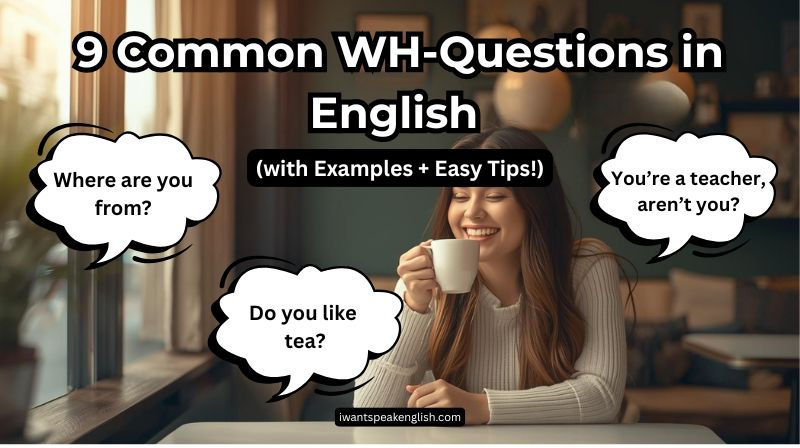
9 Common WH-Questions in English (with Examples + Easy Tips!)
Updated: 3 days ago
What are WH-Questions?
WH-questions are questions that begin with words like who, what, where, when, why, how, and more. We use them to get information, not just a “yes” or “no” answer.
These questions usually start with a WH-word, followed by an auxiliary verb, then the subject and main verb.
📕Related post
1. WHO – to ask about a person
Use: To find out who did something or who someone is.
✏️ Form:
👉 [Who + auxiliary + subject + verb] (when “who” is the object)
👉 [Who + verb (no auxiliary) ] (when “who” is the subject)
✅ Examples:
Who is your best friend?
Who called you yesterday? (“who” = subject → no auxiliary)
Who did you meet at the café? (“who” = object → use “did”)
📝 Tip:
If who = subject, don’t use do/does/did.
2. WHAT – to ask about things or actions
Use: To find out information about something.
✏️ Form:
👉 [What + auxiliary + subject + verb]
👉 [What + be + subject]
✅ Examples:
What are you eating?
What did you buy?
What is your favourite drink?
3. WHICH – to ask for a choice or option
Use: To choose from a limited set of options.
✏️ Form:
👉 [Which + noun + auxiliary + subject + verb]
👉 [Which + one + auxiliary + subject + verb]
✅ Examples:
Which dress do you like best?
Which coffee do you recommend?
Which one is better?
📝 Tip:
👉 Use “which” when the choices are known.
👉 Use “what” when the choices are open or unknown.
4. WHERE – to ask about a place
Use: To find out location or direction.
✏️ Form:
👉 [Where + auxiliary + subject + verb]
👉 [Where + be + subject]
✅ Examples:
Where do you live?
Where did you go yesterday?
Where is the café?
5. WHEN – to ask about time
Use: To find out the time or date something happens.
✏️ Form:
👉 [When + auxiliary + subject + verb ]
👉 [When + be + subject ]
✅ Examples:
When is your birthday?
When did you arrive?
When are you leaving?
6. WHY – to ask about reason or cause
Use: To ask for an explanation.
✏️ Form:
👉 [Why + auxiliary + subject + verb]
👉 [Why + be + subject]
✅ Examples:
Why are you late?
Why did you choose that café?
📝 Tip:
Answers often begin with “Because…”
7. HOW – to ask about manner, method, or condition
Use: To find out how something happens.
✏️ Form:
👉 [How + auxiliary + subject + verb]
👉 [How + be + subject]
✅ Examples:
How do you make coffee?
How are you today?
🌟 Common “HOW” Variations:
How often → frequency → How often do you go out?
How much → uncountable → How much coffee do you drink?
How many → countable → How many cups do you want?
How long → duration → How long are you staying?
WHOM – formal (object question)
Use: To ask about the person receiving the action.
✏️ Form:
👉 [Whom + auxiliary + subject + verb]
✅ Examples:
Whom did you invite?
Whom are you speaking to?
📝 Note: In everyday English, we usually say “who” instead.
9. WHOSE – to ask about possession
Use: To find out who something belongs to.
✏️ Form:
👉 [Whose + noun + be + subject]
👉 [Whose + noun + auxiliary + subject + verb]
✅ Examples:
Whose bag is this?
Whose book did you borrow?
💡 Quick Grammar Pattern (Easy Rule for Students)
👉 [WH-word + auxiliary verb + subject + main verb]
Example:
Where do you live?
Why did she leave?
🎥 Watch Youtube Shorts Video:
🔗 Learn 9 Everyday WH- Questions in just 60 Seconds
💡 Difference Between “How Often” and “When”
Expression | Meaning | Example | Expected Answer |
When | asks about a specific time | “When do you go jogging?” | “On Sundays.” / “At 7 a.m.” |
How often | asks about frequency (how many times) | “How often do you go jogging?” | “Twice a week.” / “Every day.” |
✅ Quick Tip:
Use “when” → for time.
Use “how often” → for frequency.
☕ Mini-Dialogue: A Morning at Bella’s Café
Scene: Mia and her friend Emma are having breakfast at their favourite café.
👩🦰 Mia: Hey, whose bag is that on the chair?
👩🦱 Emma: Oh, it’s Anna’s. She went to get coffee.
👩🦰 Mia: Who makes the best latte here?
👩🦱 Emma: Definitely Marco. He’s the new barista.
👩🦰 Mia: Nice! When did he start working here?
👩🦱 Emma: Last week. Why do you ask?
👩🦰 Mia: Because I’ve never seen him before. And how does he make that heart on the coffee?
👩🦱 Emma: He uses steamed milk—it looks so pretty, right?
👩🦰 Mia: Totally! Where does he learn that?
👩🦱 Emma: He studied in Italy!
👩🦰 Mia: Wow! Which coffee should I try next—cappuccino or mocha?
👩🦱 Emma: Mocha, for sure! And by the way, how often do you come here?
👩🦰 Mia: Almost every morning. It’s my happy place!
🧠 Comprehension Quiz: Bella’s Café Conversation
🔹 Part 1: Match the Questions with the Correct Answers
A. Questions B. Answers
1️⃣ Whose bag is that on the chair? __ a. Because she’s never seen him before.
2️⃣ Who makes the best latte here? __ b. Almost every morning.
3️⃣ When did Marco start working here? __ c. Mocha.
4️⃣ Why does Mia ask about Marco? __ d. Last week.
5️⃣ How does Marco make the heart __ e. He uses steamed milk.
on the coffee?
6️⃣ Where did he learn that skill? __ f. It’s Anna’s bag.
7️⃣ Which coffee does Emma recommend? __ g. Marco, the new barista.
8️⃣ How often does Mia come to the café? __ h. In Italy.
🔹 Part 2 🧋 Vocabulary Review – Café Words
Match the café word to its meaning:
Word | Meaning |
1️⃣ Barista | a. A type of coffee with chocolate and milk |
2️⃣ Latte | b. Someone who makes and serves coffee |
3️⃣ Steamed milk | c. Warm milk with froth made by steam |
4️⃣ Recommend | d. To say something is a good choice |
5️⃣ Study abroad | e. To learn in another country |
🔑 Check your answers below ⬇️
✅ Answer Key
🔹 Part 1: Match the Questions with the Correct Answers
Question | Correct Answer |
1️⃣ Whose bag is that on the chair? | f. It’s Anna’s bag. |
2️⃣ Who makes the best latte here? | g. Marco, the new barista. |
3️⃣ When did Marco start working here? | d. Last week. |
4️⃣ Why does Mia ask about Marco? | a. Because she’s never seen him before. |
5️⃣ How does Marco make the heart on the coffee? | e. He uses steamed milk. |
6️⃣ Where did he learn that skill? | h. In Italy. |
7️⃣ Which coffee does Emma recommend? | c. Mocha. |
8️⃣ How often does Mia come to the café? | b. Almost every morning. |
✅ Answer Key
🔹 Part 2 🧋 Vocabulary Review – Café Words
Word | Meaning |
1️⃣ Barista | b. Someone who makes and serves coffee |
2️⃣ Latte | a. A type of coffee with chocolate and milk |
3️⃣ Steamed milk | c. Warm milk with froth made by steam |
4️⃣ Recommend | d. To say something is a good choice |
5️⃣ Study abroad | e. To learn in another country |
💬 Mini Speaking Challenge
Try asking and answering these questions:
👉 How often do you visit a café?
👉 Where do you usually go on weekends?
👉 Who do you talk to in English?
🎯 Practice Time!
Try answering these in your notebook or ✏️ in the comments below ⬇️:
Who is your favourite singer?
_____________________________________________
What do you usually have for breakfast?
_____________________________________________
Where would you like to go this weekend?
_____________________________________________
When did you last meet your best friend?_____________________________________________
How often do you visit a café?
_____________________________________________
🌍 Real-Life WH-Questions (Everyday Situations)
Use these questions to practise English in real-life conversations.
Try answering them aloud or with a partner!
☕ 1. At a Café
What would you like to drink?
Which cake do you prefer?
Who is serving us today?
Where can we sit?
When does the café close?
Why is this place so popular?
How do you make this latte?
Whose order is this?
🛍 2. Shopping
What are you looking for today?
Which size do you need?
Who helped you choose this dress?
Where did you buy that bag?
When is the sale starting?
Why do you like this brand?
How much does this cost?
Whose jacket is this?
👩🏻🏫 Practice tip❗️
✔ Answer in full sentences
✔ Ask a follow-up question
✔ Practise with a friend or record yourself
✈️ 3. Travel
Where are you going for your next trip?
When are you leaving?
Why did you choose this destination?
How are you getting there?
Which hotel are you staying at?
Who are you travelling with?
What should I pack?
Whose passport is this?
🏠 4. At Home
Who cooked dinner today?
What are you watching?
Where did you put the keys?
When will you finish your work?
Why is the room so messy?
How do you clean this machine?
Whose phone is ringing?
💼 5. At Work
What are you working on right now?
Who is your manager?
When is the meeting?
Where is the office located?
Why is this project important?
How do we complete this task?
Which idea do you prefer?
Whom should I contact? (formal)
📩 Free PDF
👉 Download the Role-Play Worksheet + Real-Life Wh-Questions
🧘♀️ 6. Lifestyle & Daily Routine
What do you usually do in the morning?
When do you exercise?
How often do you go to the gym?
Why do you enjoy yoga?
Where do you relax after work?
Who do you spend weekends with?
Which activity helps you relax the most?
❓ Frequently Asked Questions - WH-Questions in English
1. What are WH-questions in English?
WH-questions are questions that usually begin with words such as who, what, which, where, when, why, and how. They are used to ask for specific information rather than a simple yes or no answer.
Example:
Where do you live?
Why are you learning English?
What do you usually do at weekends?
2. What are the 9 common WH-question words?
The 9 commonly taught WH-question words are:
who, what, which, where, when, why, how, whom, and whose.
Each one asks for a different type of information:
Who → person
What → thing or information
Which → choice
Where → place
When → time
Why → reason
How → manner, method or condition
Whom → person receiving an action; formal
Whose → possession
3. What is the basic structure of a WH-question?
A common structure is:
WH-word + auxiliary verb + subject + main verb
For example:
Where do you live?
Why did she leave?
What are they doing?
However, the structure can change when be is the main verb or when the WH-word is the subject.
4. What is the difference between “what” and “which”?
What is generally used when the possible answers are open or not limited.
What do you want to eat?
Which is generally used when choosing from a limited or known set of options.
Which dessert would you like — the cake or the cheesecake?
💡 Easy tip:
What = open choice
Which = limited choice
5. What is the difference between “when” and “how often”?
When asks about time.
When do you go to the gym?
On Saturday mornings.
How often asks about frequency.
How often do you go to the gym?
Twice a week.
💡 Remember:
WHEN → time 🕐
HOW OFTEN → frequency 🔄
6. What is the difference between “who” and “whom”?
Who is used to ask about a person and is very common in everyday English.
Who did you invite?
Whom is traditionally used when the person is the object of the verb and is more formal.
Whom did you invite?
In everyday conversation, who is much more common:
Who are you talking to?
You will still see whom in formal writing and expressions such as:
To whom it may concern.
7. What is the difference between “whose” and “who’s”?
These two words sound the same, but they have different meanings.
Whose = possession
Whose bag is this?
Who’s = who is or who has
Who’s coming to the café?(Who is coming?)
💡 Quick test:
If you can replace it with who is or who has, use who’s.
8. Can a WH-question begin with “how”?
Yes! How is a very common question word.
How are you?
How do you make coffee?
How did you get there?
It can also combine with other words:
How often → frequency
How long → duration
How much → amount/price
How many → number
How far → distance
**How
☕ Love English + Café Culture?
Check out more fun café-themed lessons here:
📘 Related Grammar Posts:
Check out more related posts below ⬇️
🔔 Practice More
Want to improve your listening and speaking skills?
🎥 Check out our YouTube Channel Playlist:
🔗 Learn Vocabulary Through Stories - Fun & Easy
Watch and Learn!
For more ESL reading and listening practice video lessons, subscribe to our YouTube channel.
✅ If you liked this post, subscribe to our free newsletter for more.
Thanks so much for reading & Happy learning! 🌟


Comments